



How to Choose the Right Boat Transducer: 2026 Buyer’s Guide
Quick answer: Choose a boat transducer only after matching the exact chartplotter or sounder, sonar technology, connector and power requirements. Then select a mounting style that fits your hull material, deadrise, propulsion, trailering habits, fishing depth and the clean-water location available on your boat. A transducer that physically plugs in is not automatically compatible.
The transducer is the part of a sonar system that sends sound into the water and receives the returning echoes. It has an enormous influence on bottom tracking, target separation, depth capability and image quality. This guide will help you narrow the right type before you order—but the final model should always be confirmed against current manufacturer compatibility documentation.
The six decisions that determine the right transducer
Record the exact display or sounder model, sonar ports, software generation and approved transducer list.
Traditional depth, CHIRP, down imaging, side imaging, live sonar and forward-looking sonar require different hardware.
Freshwater, coastal, offshore, cruising, wreck fishing and high-speed bottom tracking create different priorities.
Confirm hull material, construction, deadrise, steps, strakes, propulsion and trailer or lift contact points.
Compare transom, trolling-motor, in-hull, flush thru-hull and fairing-block installations.
Plan clean water, cable routing, service access, sealing, power and final on-water testing.
First rule: match the transducer to the display or sounder
Start with the manufacturer’s current compatibility table—not connector appearance, an online comment or the fact that two products share a brand. Confirm all of the following:
- exact chartplotter, fishfinder or sounder-module model;
- supported sonar technologies and frequencies;
- transducer connector and pin configuration;
- maximum supported transducer power and required impedance;
- whether an approved adapter, sonar module or network component is required;
- whether every desired feature works through that adapter;
- software or hardware-generation restrictions.
If an existing transducer is already installed, photograph its label and connector, then record the full part number. A product-family name alone is often not enough.
Which sonar technology do you need?
| Sonar type | Best for | Important buying check |
|---|---|---|
| Traditional 2D sonar | Depth, bottom contour and fish arches beneath the boat | Frequency, cone angle, power and depth range |
| CHIRP sonar | Improved target separation and detail across a frequency sweep | Low, medium or high band; display/sounder support; transducer rating |
| Down imaging | Photo-like structure detail directly below the boat | Brand-specific technology, frequency and compatible port |
| Side imaging | Searching structure and fish to both sides | Clearance from lower units, hull features and other obstructions |
| Live sonar | Real-time lure, fish and structure movement | Required module, power, orientation and specialized mount |
| Forward-looking sonar | Viewing ahead for navigation awareness or fishing | Beam geometry, mounting position, speed limits and intended use |
Names and feature sets vary by manufacturer. Do not assume similarly described sonar modes are interchangeable across ecosystems.
CHIRP frequency: low, medium or high?
Low-frequency CHIRP
Often selected for greater depth and wider coverage in offshore applications. The transducer and sounder must be rated for the intended power and band.
Medium-frequency CHIRP
A useful balance of coverage, depth and target detail for many coastal and offshore applications.
High-frequency CHIRP
Often chosen for finer detail and target separation in shallower water, typically with a narrower beam.
Frequency is only one part of performance. Beam width, element design, output power, installation quality, water conditions and sounder processing also matter.
Transom mount vs thru-hull vs in-hull
| Mounting style | Advantages | Tradeoffs and checks |
|---|---|---|
| Transom mount | Accessible, relatively economical, adjustable and practical for many trailered boats | Exposed to impact; performance suffers in aerated or turbulent water; must clear propeller and lower-unit interference |
| Trolling-motor or pole mount | Useful for freshwater fishing, live sonar and flexible aiming | Confirm shaft clearance, cable movement, stow/deploy path and orientation |
| In-hull / shoot-through | No exterior hole, drag or marine growth on the transducer | Typically requires suitable solid fiberglass; signal loss is possible; test the location before permanent bonding |
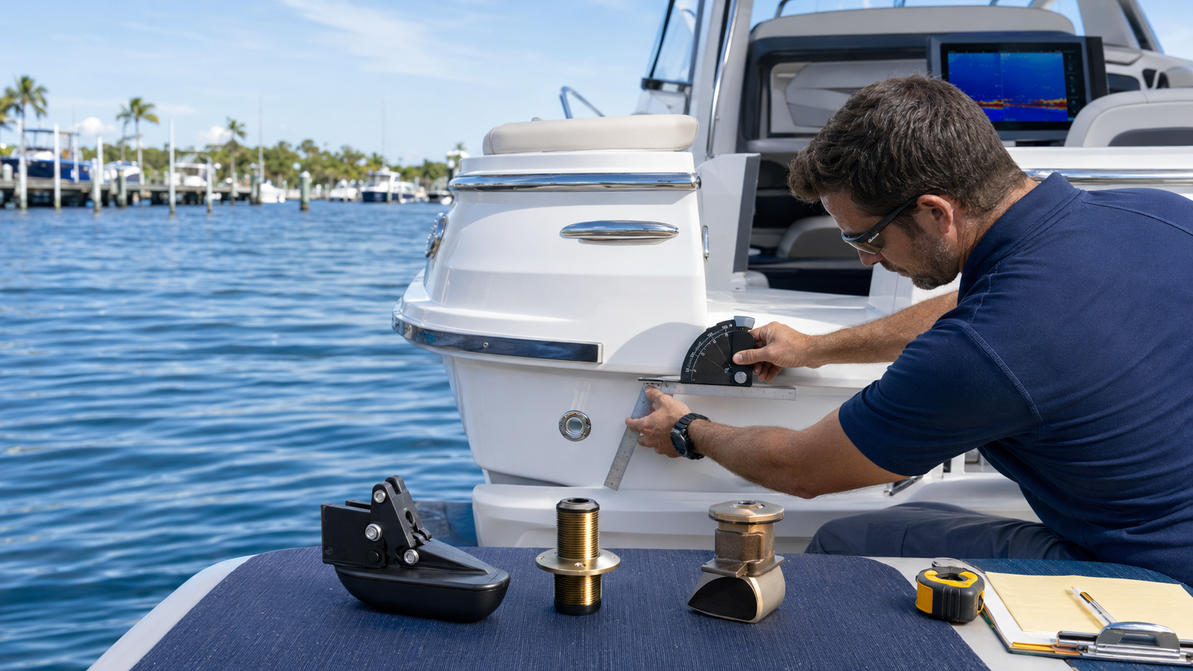
| Flush thru-hull | Low drag and strong access to clean water | Requires a hull penetration; tilted elements must match the installation deadrise range |
| External thru-hull with fairing | Can keep the element aimed vertically and perform well at speed or depth | More complex installation, added drag and careful fairing alignment; professional installation is strongly recommended |
Hull material changes the answer
- Solid fiberglass: compatible with many mounting styles and often suitable for an approved in-hull transducer.
- Cored fiberglass: requires a manufacturer-approved installation method that protects the core from water intrusion. Do not treat it like solid fiberglass.
- Aluminum: check the transducer housing material and manufacturer guidance to avoid incompatible-metal corrosion. Plastic or stainless options are commonly considered depending on the application.
- Steel: requires an appropriate housing, isolation and installation method. Manufacturer and professional guidance are important.
- Wood: hull movement and swelling require an installation designed for wood construction; seek experienced professional guidance.
Deadrise and tilted-element transducers
Deadrise is the angle between the hull bottom and a horizontal plane at the mounting location. If a sonar element points sideways instead of vertically, depth and target presentation may suffer. A tilted-element thru-hull places the element at a built-in angle to compensate for a range of hull deadrise.
Clean water is essential
A correctly matched transducer can still perform badly when installed in aerated or turbulent water. Strakes, steps, rivets, through-hulls, intakes, damaged surfaces, chines and running gear can introduce bubbles across the transducer face. The preferred location also depends on outboard, sterndrive, inboard or pod propulsion.
- Inspect water flow and hull features ahead of the proposed location.
- Keep side-imaging beams clear of engines, hulls and other obstructions.
- Check trailer bunks, rollers, slings and lift points.
- Leave service access inside the hull.
- Follow the manufacturer’s separation and orientation instructions exactly.
Common transducer-buying mistakes
Buying by plug shape
Similar connectors can hide different wiring, sonar technology or power requirements.
Ignoring the hull
The right electronics with the wrong housing, tilt or mounting location can become an expensive installation problem.
Choosing only by maximum depth
Real performance varies with frequency, power, installation, bottom type, sea state and water conditions.
Mounting behind turbulence
Bubbles interrupt acoustic contact and can cause bottom loss or noisy images at speed.
Forgetting future upgrades
Plan for the sonar views, second display or sounder module you may add later.
Drilling before a dry fit
Check both sides of the hull, cable reach, service access and interference before making a permanent opening.
Information to collect before ordering
- boat make, model, year, length and hull material;
- propulsion type and number of engines;
- exact display and sounder model numbers;
- existing transducer part number and connector photo;
- primary boating area, fishing depth and target species;
- desired sonar views;
- deadrise at the proposed mounting location;
- photos inside and outside the hull;
- trailering, lift and storage details;
- DIY or professional installation plan.
Frequently asked questions
Can I use an adapter to connect my old transducer?
Sometimes, but an adapter does not guarantee that every frequency, temperature sensor or imaging feature will work. Confirm the exact old transducer, new display and approved adapter with the manufacturer.
Is a 1 kW transducer always better than a 600 W model?
No. More power may help in demanding deep-water applications, but the sounder must support it and the frequency, beam, installation and fishing conditions must fit the mission.
Can an in-hull transducer shoot through any fiberglass hull?
No. In-hull performance generally requires a suitable solid-fiberglass location without core, trapped air or other material in the acoustic path. Follow the exact manufacturer instructions and test before permanent bonding.
Why does my fishfinder lose bottom when the boat speeds up?
Common causes include turbulence or bubbles across the transducer, incorrect height or angle, hull obstruction, damage, fouling, wiring or power problems, and unsuitable placement. Diagnose the installation before assuming the display is defective.
Do I need a professional installer?
A qualified installer is strongly advisable for thru-hull work, cored or unfamiliar hulls, high-power sonar, complex networking, difficult cable routing or any installation where water intrusion or structural damage is possible.
Choose a transducer that fits the whole system
Match the boat, display, sonar technology, hull and installation before you buy. Send MarineWaze the model numbers and boat details when you need help narrowing the correct option.
Shop boat transducers Ask a compatibility questionMarineWaze editorial note: Compatibility and installation requirements vary by exact model, software, vessel and region. Confirm current manufacturer documentation before purchase or installation. This educational guide does not replace a product manual, qualified installer or applicable safety requirements.
Recent Posts
-
How to Choose the Right Boat Transducer: 2026 Buyer’s Guide
Quick answer: Choose a boat transducer only after matching the exact chartplotter or sounder, s …Jul 24th 2026 -
How to Choose a Marine GPS Chartplotter: 2026 Buyer’s Guide
Choose the display, charts, sonar and network as one compatible marine electronics system. Quick …Feb 26th 2026